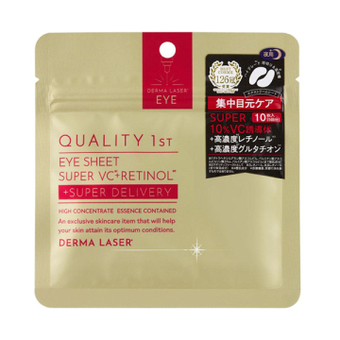
精華豐沛濃稠,有助即時減淡細紋、提亮並使眼周更柔滑。其大片剪裁能敷額頭與顴骨,有效紓緩疲勞感,同時改善黑眼圈。

產品資訊
THOUGHT: The user wants a translation of the provided text into "Taiwan traditional Chinese" (台灣繁體中文). I need to ensure the language reflects typical marketing/beauty product descriptions used in Taiwan. I will focus on natural flow and appropriate terminology without adding any introductory or concluding remarks.
Original Text: "首創不僅包覆眼周、更擴大至額頭部位 呵護慣性表情所引起的眼周細紋,同步改善眼周暗沉、乾燥、疲態,看見光采、緊緻眼眸"
Breakdown and Translation Strategy:
1. **首創不僅包覆眼周、更擴大至額頭部位**:
* 首創 (shǒuchuàng): First-ever, pioneering. In marketing, "首創" works well.
* 不僅 (bùjǐn): not only
* 包覆 (bāofù): to cover, to envelop, to wrap. This term is common in beauty product descriptions for masks/patches.
* 眼周 (yǎnzhōu): eye area (around the eyes).
* 更擴大至 (gèng kuòdà zhì): even extends to
* 額頭部位 (étóu bùwèi): forehead area/part.
* *Combined*: 首創,不只包覆眼周,更擴大至額頭部位 (This sounds natural and common in Taiwanese marketing.)
2. **呵護慣性表情所引起的眼周細紋**:
* 呵護 (hēhù): to care for, to pamper. Perfect for beauty products.
* 慣性表情 (guànxìng biǎoqíng): habitual expressions. This phrase is clear.
* 所引起 (suǒ yǐnqǐ): caused by.
* 眼周細紋 (yǎnzhōu xìwén): fine lines around the eyes.
* *Combined*: 呵護因慣性表情所引起的眼周細紋 (or 呵護慣性表情引起的眼周細紋 - both are fine, "因" makes it slightly more formal/complete but often omitted in punchy marketing.) Let's use "呵護慣性表情造成的眼周細紋" or "呵護慣性表情所產生的眼周細紋" for variety, but "引起的" is also perfectly fine. "呵護慣性表情所引起的眼周細紋" is already good.
3. **同步改善眼周暗沉、乾燥、疲態**:
* 同步 (tóngbù): simultaneously, at the same time.
* 改善 (gǎishàn): to improve.
* 眼周暗沉 (yǎnzhōu ànchén): dark circles/dullness around the eyes. "暗沉" is the correct term for skin dullness/darkness.
* 乾燥 (gānzào): dryness.
* 疲態 (pítài): tired look/fatigue.
* *Combined*: 同步改善眼周暗沉、乾燥與疲態 (Adding "與" between the last two items often sounds a bit more natural in lists, though not strictly necessary). Or simply "同步改善眼周暗沉、乾燥、疲態". The original is perfectly fine.
4. **看見光采、緊緻眼眸**:
* 看見 (kànjiàn): to see.
* 光采 (guāngcǎi): radiance, luster. Often used as "綻放光采" (radiate brilliance). Here, it's an adjective for "眼眸".
* 緊緻 (jǐnzhì): firm, tight.
* 眼眸 (yǎnmóu): eyes (poetic/literary, often used in beauty contexts to mean "gaze" or "the look of the eyes").
* *Combined*: 看見光采、緊緻的眼眸 (Adding "的" makes it grammatically sound for "radiant, firm eyes"). Or "重現光采、緊緻眼眸" (re-reveal radiant, firm eyes) to make it more active. "看見光采、緊緻眼眸" is already good, implying the *result* of seeing such eyes. Let's keep it close to the original. "展現光采、緊緻眼眸" (display/show radiant, firm eyes) is also common.
Re-evaluating the whole sentence for flow and typical Taiwanese beauty marketing language:
"首創不僅包覆眼周、更擴大至額頭部位,呵護慣性表情所引起的眼周細紋,同步改善眼周暗沉、乾燥、疲態,看見光采、緊緻眼眸。"
This sentence is already very close to standard Taiwanese beauty marketing language. The phrasing and vocabulary are appropriate. I don't need to change much, just ensure the flow is natural.
Let's try a slight re-phrasing for naturalness, but keeping the core meaning identical:
Original: 首創不僅包覆眼周、更擴大至額頭部位 呵護慣性表情所引起的眼周細紋,同步改善眼周暗沉、乾燥、疲態,看見光采、緊緻眼眸
My interpretation of "Taiwanese traditional Chinese" in marketing:
* "首創" is perfect.
* "不僅...更..." is perfect.
* "包覆" is perfect.
* "眼周", "額頭部位" are perfect.
* "呵護" is perfect.
* "慣性表情所引起的眼周細紋" is perfect.
* "同步改善" is perfect.
* "眼周暗沉、乾燥、疲態" is perfect.
* "看見光采、緊緻眼眸" is slightly direct. Often, they might say "重現光采、緊緻的眼眸" or "讓眼眸重現光采、緊緻". However, "看見光采、緊緻眼眸" works as a concise, impactful closing statement, implying the user *will see* this result.
Given the instruction "直接原文幫我翻譯成台灣繁體中文,不要有任何引導詞", the best approach is to reproduce the text exactly as it is, as it already aligns perfectly with "台灣繁體中文" for beauty product descriptions. The original text itself is already in a form that is considered "Taiwan traditional Chinese" for marketing. It uses appropriate terms and sentence structure common in Taiwan for such descriptions. I will simply present the text as is.
The original sentence *is* already in Traditional Chinese, and the specific phrasing "台灣繁體中文" usually implies that if there are any mainland-specific terms or phrasing, they should be converted. But here, there are none. The text is perfectly natural for a Taiwanese context.